Oeneus
Mortal man
In Greek mythology, Oeneus (; Ancient Greek: Οἰνεύς, romanized: Oineús, lit. 'Wine-man') was a Calydonian king. He was the first who received a vine-plant from Dionysos.
Explore on the graph- Mentions
- 6
- Connected characters
- 7
- Books
- 5


Mentions in the Iliad
A. T. Murray, Loeb Classical Library, Harvard University Press, 1924 · Homer, Iliad with an English Translation · CC BY-SA 3.0 US
“and held the mainland and dwelt on the shores over against the isles. Of these was Odysseus captain, the peer of Zeus in counsel. And with him there followed twelve ships with vermilion prows. And the Aetolians were led by Thoas, Andraemon's son, even they that dwelt in Pleuron and Olenus and Pylene and Chalcis, hard by the sea, and rocky Calydon. For the sons of great-hearted Oeneus were no more, neither did he himself still live, and fair-haired Meleager was dead, to whom had commands been given that he should bear full sway among the Aetolians. And with Thoas there followed forty black ships.”

“and of a ready heart I bid thee fight with the Trojans, yet either hath weariness born of thy many onsets entered into thy limbs, or haply spiritless terror possesseth thee. Then art thou no offspring of Tydeus, the wise-hearted son of Oeneus. Then in answer to her spake mighty Diomedes:”

“Verily now art thou a friend of my father's house from of old: for goodly Oeneus on a time entertained peerless Bellerophon in his halls, and kept him twenty days; and moreover they gave one to the other fair gifts of friendship. Oeneus gave a belt bright with scarlet,”
“around the city of Calydon, and were slaying one another, the Aetolians defending lovely Calydon and the Curetes fain to waste it utterly in war. For upon their folk had Artemis of the golden throne sent a plague in wrath that Oeneus offered not to her the first-fruits of the harvest in his rich orchard land;”
“and the half clear plough-land, to be cut from out the plain. And earnestly the old horseman Oeneus besought him, standing upon the threshold of his high-roofed chamber, and shaking the jointed doors, in prayer to his son, and earnestly too did his sisters and his honoured mother beseech him”
“For to Portheus were born three peerless sons, and they dwelt in Pleuron and steep Calydon, even Agrius and Melas, and the third was the horseman Oeneus, that was father to my father, and in valour was pre-eminent among them. He verily abode there, but my father went wandering to Argos, and there was settled,”
See all 6
Connections
Father · Sources
For to Portheus were born three peerless sons, and they dwelt in Pleuron and steep Calydon, even Agrius and Melas, and the third was the horseman Oeneus, that was father to my father, and in valour was pre-eminent among them. He verily abode there, but my father went wandering to Argos, and there was settled,
Il. 14.115–117
Brother · Sources
Братство или сестринство выведено из общего родителя: Порфей. Матери и отцы, не указанные в источнике, не предполагаются.
For to Portheus were born three peerless sons, and they dwelt in Pleuron and steep Calydon, even Agrius and Melas, and the third was the horseman Oeneus, that was father to my father, and in valour was pre-eminent among them. He verily abode there, but my father went wandering to Argos, and there was settled,
Il. 14.115–117
Brother · Sources
Братство или сестринство выведено из общего родителя: Порфей. Матери и отцы, не указанные в источнике, не предполагаются.
For to Portheus were born three peerless sons, and they dwelt in Pleuron and steep Calydon, even Agrius and Melas, and the third was the horseman Oeneus, that was father to my father, and in valour was pre-eminent among them. He verily abode there, but my father went wandering to Argos, and there was settled,
Il. 14.115–117
Son · Sources
and held the mainland and dwelt on the shores over against the isles. Of these was Odysseus captain, the peer of Zeus in counsel. And with him there followed twelve ships with vermilion prows. And the Aetolians were led by Thoas, Andraemon's son, even they that dwelt in Pleuron and Olenus and Pylene and Chalcis, hard by the sea, and rocky Calydon. For the sons of great-hearted Oeneus were no more, neither did he himself still live, and fair-haired Meleager was dead, to whom had commands been given that he should bear full sway among the Aetolians. And with Thoas there followed forty black ships.
that wrought much evil, wasting the orchard land of Oeneus; many a tall tree did he uproot and cast upon the ground, aye, root and apple blossom therewith. But the boar did Meleager, son of Oeneus, slay, when he had gathered out of many cities huntsmen
Il. 2.641–642 · Il. 9.543
Son · Sources
and of a ready heart I bid thee fight with the Trojans, yet either hath weariness born of thy many onsets entered into thy limbs, or haply spiritless terror possesseth thee. Then art thou no offspring of Tydeus, the wise-hearted son of Oeneus. Then in answer to her spake mighty Diomedes:
For to Portheus were born three peerless sons, and they dwelt in Pleuron and steep Calydon, even Agrius and Melas, and the third was the horseman Oeneus, that was father to my father, and in valour was pre-eminent among them. He verily abode there, but my father went wandering to Argos, and there was settled,
Il. 5.813 · Il. 14.118
Grandson · Sources
Происхождение выведено по цепочке родителей: Иней → Тидей → Диомед Тидид.
Nestor, first of all, and king Idomeneus, and thereafter the twain Aiantes and the son of Tydeus, and as the sixth Odysseus, the peer of Zeus in counsel. And unbidden came to him Menelaus, good at the war-cry, for he knew in his heart wherewith his brother was busied.
Ah me, thou son of wise-hearted Tydeus, tamer of horses, why cowerest thou, why gazest thou at the dykes of battle? Tydeus of a surety was not wont thus to cower, but far in advance of his comrades to fight against the foe, as they tell who saw him amid the toil of war; for I never
and Autophonus' son, Polyphontes, staunch in fight. But Tydeus even upon these let loose a shameful fate, and slew them all; one only man suffered he to return home; Maeon he sent forth in obedience to the portents of the gods. Such a man was Tydeus of Aetolia; howbeit the son
Il. 2.406 · Il. 4.370 · Il. 4.399 · Il. 5.1 · Il. 5.97 · Il. 5.116 · Il. 5.134 · Il. 5.163 · Il. 5.184 · Il. 5.207 · Il. 5.241 · Il. 5.277 · Il. 5.330 · Il. 5.335 · Il. 5.362 · Il. 5.410 · Il. 5.441 · Il. 5.519 · Il. 5.596 · Il. 5.800 · Il. 5.813 · Il. 5.826 · Il. 5.837 · Il. 5.866 · Il. 5.881 · Il. 6.96 · Il. 6.119 · Il. 6.122 · Il. 6.216 · Il. 6.222–223 · Il. 6.277 · Il. 6.437 · Il. 7.163 · Il. 7.404 · Il. 8.115 · Il. 8.145 · Il. 8.254 · Il. 8.532 · Il. 9.53 · Il. 10.150 · Il. 10.234 · Il. 10.285–286 · Il. 10.366 · Il. 10.508 · Il. 10.516 · Il. 11.312 · Il. 11.333 · Il. 11.660 · Il. 14.29 · Il. 14.113–114 · Il. 14.118 · Il. 16.74 · Il. 19.48 · Il. 21.396 · Il. 23.357 · Il. 23.383 · Il. 23.472 · Il. 23.812
Friend · Sources
Verily now art thou a friend of my father's house from of old: for goodly Oeneus on a time entertained peerless Bellerophon in his halls, and kept him twenty days; and moreover they gave one to the other fair gifts of friendship. Oeneus gave a belt bright with scarlet,and Bellerophon a double cup of gold which I left in my palace as I came hither. But Tydeus I remember not, seeing I was but a little child when he left, what time the host of the Achaeans perished at Thebes. Therefore now am I a dear guest-friend to thee in the midst of Argos,
Il. 6.215–220
See all 7
In art

Miroir à manche gravé avec décor de scène mythologique - Musée du Louvre AGER ED 2837 ; INV 1041 ; Br 1749. Department of Greek, Etruscan, and Roman Antiquities of the Louvre. CC0. https://www.wikidata.org/wiki/Q124757393

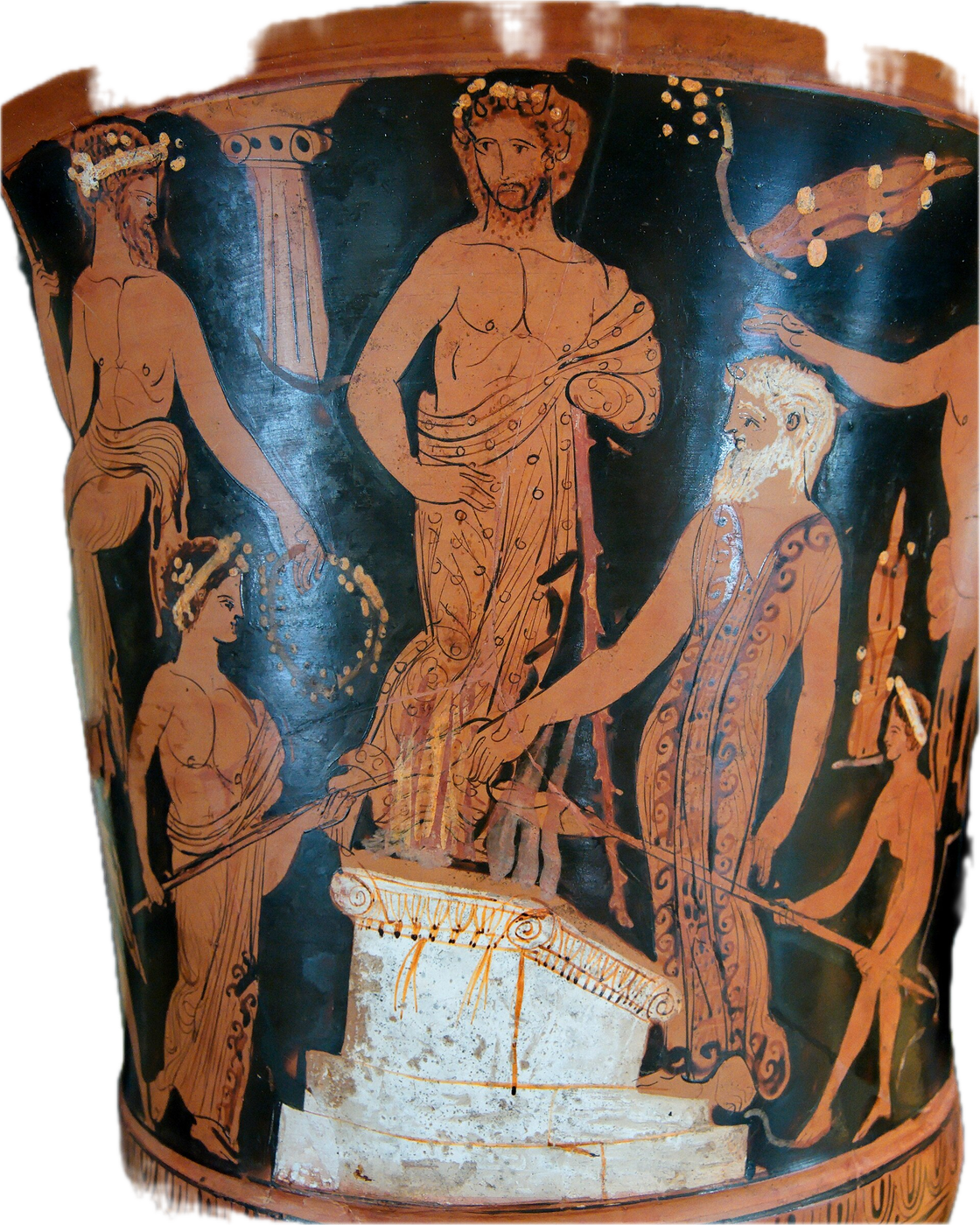
Heracles amphora. National Archaeological Museum of Athens. CC BY-SA 3.0. https://www.wikidata.org/wiki/Q1569735
See all 2
04 / PROVENANCE
Sources and verification
The character is matched to the catalogue.
- Wikipedia · Oeneus · CC BY-SA 4.0
Excerpt; remaining sentences omitted.
Reference material remains distinct from the poem’s assertions. Characters who share a name retain separate pages.