Tydeus
Mortal man
Tydeus (; Ancient Greek: Τυδεύς Tūdeus) was an Aetolian hero in Greek mythology, belonging to the generation before the Trojan War. He was one of the Seven against Thebes, and the father of Diomedes, who is frequently known by the patronymic Tydides.
Explore on the graph
- Mentions
- 53
- Connected characters
- 4
- Books
- 14


Mentions in the Iliad
A. T. Murray, Loeb Classical Library, Harvard University Press, 1924 · Homer, Iliad with an English Translation · CC BY-SA 3.0 US
“Nestor, first of all, and king Idomeneus, and thereafter the twain Aiantes and the son of Tydeus, and as the sixth Odysseus, the peer of Zeus in counsel. And unbidden came to him Menelaus, good at the war-cry, for he knew in his heart wherewith his brother was busied.”

“Ah me, thou son of wise-hearted Tydeus, tamer of horses, why cowerest thou, why gazest thou at the dykes of battle? Tydeus of a surety was not wont thus to cower, but far in advance of his comrades to fight against the foe, as they tell who saw him amid the toil of war; for I never”
“and the men of Mycenae were minded to grant them, and were assenting even as they bade, but Zeus turned their minds by showing tokens of ill. So when they had departed and were with deep reeds, that coucheth in the grass, there did the Achaeans send forth Tydeus on an embassage.”
“And now to Tydeus' son, Diomedes, Pallas Athene gave might and courage, that he should prove himself pre-eminent amid all the Argives, and win glorious renown. She kindled from his helm and shield flame unwearying,”
“But when the glorious son of Lycaon was ware of him as he raged across the plain and drove the battalions in rout before him, forthwith he bent against the son of Tydeus his curved bow, and with sure aim smote him as he rushed onwards upon the right shoulder on the plate of his corselet; through this sped the bitter arrow”
“the son of Zeus, sped me on my way when I set forth from Lycia. So spake he vauntingly; howbeit that other did the swift arrow not lay low, but he drew back, and took his stand before his horses and chariot, and spake to Sthenelus, son of Capaneus: Rouse thee, good son of Capaneus; get thee down from the car,”
“for in thy breast have I put the might of thy father, the dauntless might, such as the horseman Tydeus, wielder of the shield, was wont to have. And the mist moreover have I taken from thine eyes that afore was upon them, to the end that thou mayest well discern both god and man. Wherefore now if any god come hither to make trial of thee,”
See all 53
“Echemmon and Chromius, the twain being in one car. Even as a lion leapeth among the kine and breaketh the neck of a heifer or a cow as they graze in a woodland pasture, so did Tydeus' son thrust both these in evil wise from their car, sorely against their will, and thereafter despoiled them of their armour;”
“Aeneas, counsellor of the brazen-coated Trojans, to the wise-hearted son of Tydeus do I liken him in all things, knowing him by his shield and his crested helm, and when I look on his horses; yet I know not surely if he be not a god. But if he be the man I deem him, even the wise-hearted son of Tydeus,”
“but this, meseems, was to avail me not. Already have I let fly a shaft at two chieftains, the son of Tydeus and Atreus' son, and smitten them fairly, and from them both of a surety I drew forth blood, yet did I but arouse them the more. Wherefore with ill hap was it that I took from the peg my curved bow”

“Aeneas, keep thou the reins thyself, and drive thine own horses; better will they draw the curved car under their wonted charioteer, if so be we must flee from the son of Tydeus. I would not that they take fright and run wild, and for want of thy voice be not minded to bear us forth from the battle,”
“and forthwith drew near those other twain, driving the swift horses. And Lycaon's glorious son spake first to him, saying: Thou son of lordly Tydeus, stalwart and wise of heart, verily my swift shaft subdued thee not, the bitter arrow; now will I again make trial of thee with my spear, if so be I may hit thee.”
“He the while had gone in pursuit of Cypris with his pitiless bronze, discerning that she was a weakling goddess, and not one of those that lord it in the battle of warriors,—no Athene she, nor Enyo, sacker of cities. But when he had come upon her as he pursued her through the great throng,”
“then the son of great-souled Tydeus thrust with his sharp spear and leapt upon her, and wounded the surface of her delicate hand, and forthwith through the ambrosial raiment that the Graces themselves had wrought for her the spear pierced the flesh upon the wrist above the palm and forth flowed the immortal blood of the goddess,”
“that I may get me to Olympus, where is the abode of the immortals. For sorely am I pained with a wound which a mortal man dealt me, Tydeus' son, that would now fight even with father Zeus. So spake she, and Ares gave her his horses with frontlets of gold; and she mounted upon the car, her heart distraught,”
“Wherefore now let Tydeus' son, for all he is so mighty, beware lest one better than thou fight against him, lest in sooth Aegialeia, the daughter of Adrastus, passing wise, wake from sleep with her long lamentings all her household, as she wails for her wedded husband, the best man of the Achaeans, even she,”
“Bethink thee, son of Tydeus, and give place, neither be thou minded to be like of spirit with the gods; seeing in no wise of like sort is the race of immortal gods and that of men who walk upon the earth. So spake he, and the son of Tydeus gave ground a scant space backward, avoiding the wrath of Apollo that smiteth afar.”
“as they saw him come to join them alive and whole and possessed of valiant courage. Howbeit they questioned him not at all, for toil of other sort forbade them, even that which he of the silver bow was stirring, and Ares the bane of mortals, and Discord that rageth without ceasing. On the other side the Aiantes twain and Odysseus and Diomedes”
“and ranged now in front of Hector and now behind him. At sight of him Diomedes, good at the war-cry shuddered; and even as a man in passing over a great plain halteth in dismay at a swift-streaming river that floweth on to the sea, and seeing it seething with foam starteth backward,”

“Verily little like himself was the son that Tydeus begat. Tydeus was small in stature, but a warrior. Even when I would not suffer him to fight or make a show of prowess, what time he came, and no Achaean with him, on an embassage to Thebes into the midst of the many Cadmeians—”
“And the goddess, flashing-eyed Athene, answered him, saying: Son of Tydeus, Diomedes, dear to my heart, fear thou not Ares for that, neither any other of the immortals; so present a helper am I to thee. Nay, come, at Ares first drive thou thy single-hooved horses,”
“So saying, with her hand she drew back Sthenelus, and thrust him from the car to earth, and he speedily leapt down; and she stepped upon the car beside goodly Diomedes, a goddess eager for battle. Loudly did the oaken axle creak beneath its burden, for it bare a dread goddess and a peerless warrior.”
“when after heat a blustering wind ariseth, even in such wise unto Diomedes, son of Tydeus, did brazen Ares appear, as he fared amid the clouds unto broad heaven. Speedily he came to the abode of the gods, to steep Olympus, and sate him down by the side of Zeus, son of Cronos, grieved at heart, and shewed the immortal blood flowing from the wound,”
“but rather settest her on, for that this pestilent maiden is thine own child. Now hath she set on the son of Tydeus, Diomedes high of heart, to vent his rage upon immortal gods. Cypris first he wounded with a thrust in close fight upon the hand at the wrist, and thereafter rushed upon mine own self as he had been a god.”
“on the city and the Trojan's wives and their little children; in hope she may hold back from sacred Ilios the son of Tydeus, that savage spearman, a mighty deviser of rout, who has verily, meseems, proved himself the mightiest of the Achaeans. Not even Achilles did we ever fear on this wise, that leader of men,”






“to make prayer to the gods, and promise them hecatombs. So saying, Hector of the flashing helm departed, and the black hide at either end smote against his ankles and his neck, even the rim that ran about the outermost edge of his bossed shield. But Glaucus, son of Hippolochus, and the son of Tydeus”
“came together in the space between the two hosts, eager to do battle. And when the twain were now come near as they advanced one against the other, Diomedes, good at the war-cry, was first to speak, saying: Who art thou, mighty one, among mortal men? For never have I seen thee in battle where men win glory”
“and Bellerophon a double cup of gold which I left in my palace as I came hither. But Tydeus I remember not, seeing I was but a little child when he left, what time the host of the Achaeans perished at Thebes. Therefore now am I a dear guest-friend to thee in the midst of Argos,”
“if she will take pity on Troy and the Trojans' wives and their little children; in hope she may hold back the son of Tydeus from sacred Ilios, that savage spearman, a mighty deviser of rout. So go thou to the temple of Athene, driver of the spoil;”
“For thrice at this point came the most valiant in company with the twain Aiantes and glorious Idomeneus and the sons of Atreus and the valiant son of Tydeus, and made essay to enter: whether it be that one well-skilled in soothsaying told them, or haply their own spirit urgeth and biddeth them thereto.”
“even ye are not minded with a ready heart to meet Hector face to face. So the old man chid them, and there stood up nine in all. Upsprang far the first the king of men, Agamemnon, and after him Tydeus' son, mighty Diomedes, and after them the Aiantes, clothed in furious valour,”
“Let no man now accept the treasure from Alexander, nay, nor Helen; known is it, even to him who hath no wit at all, that now the cords of destruction are made fast upon the Trojans. So spake he, and all the sons of the Achaeans shouted aloud, applauding the saying of Diomedes, tamer of horses.”
“and the other twain mounted both upon the car of Diomedes. Nestor took in his hands the shining reins, and touched the horses with the lash, and speedily they drew nigh to Hector. Upon him then as he charged straight at them the son of Tydeus made a cast: him he missed, but his squire that drave the chariot, Eniopeus, son of Thebaeus, high of heart,”
“Then had ruin come and deeds beyond remedy been wrought, and they had been penned in Ilios like lambs, had not the father of men and gods been quick to see. He thundered terribly and let fly his white lightning-bolt, and down before the horses of Diomedes he hurled it to earth;”
“even where the Achaeans were wont to offer sacrifice to Zeus from whom all omens come. So they, when they saw that it was from Zeus that the bird was come, leapt the more upon the Trojans and bethought them of battle. Then might no man of the Danaans, for all they were so many, vaunt that he before the son of Tydeus guided his swift horses”
“but in the morning at the coming of dawn arrayed in our armour let us arouse sharp battle at the hollow ships. I shall know whether the son of Tydeus, mighty Diomedes, will thrust me back from the ships to the wall, or whether I shall slay him with the bronze and bear off his bloody spoils.”
“So spake he, and all the sons of the Achaeans shouted aloud, applauding the word of Diomedes, tamer of horses. Then uprose and spake among them the horseman Nestor: Son of Tydeus, above all men art thou mighty in battle,”
“And they came to Tydeus' son, Diomedes, and him they found outside his hut with his arms; and around him his comrades were sleeping with their shields beneath their heads, but their spears were driven into the ground erect on their spikes, and afar shone the bronze like the lightning of father Zeus. But the warrior was sleeping,”
“fain was the son of Atreus, Menelaus, famed for his spear, and fain too was the stead-fast Odysseus to steal into the throng of the Trojans, for ever daring was the spirit in his breast. Then among them spake the king of men, Agamemnon: Diomedes, son of Tydeus, dear to my heart,”
“But when he was now about to come among the sentinels, as he fled towards the ships, then verily Athene put strength into Tydeus' son, that no man among the brazen-coated Achaeans might before him boast to have dealt the blow, and he come too late. And mighty Diomedes rushed upon him with his spear, and called:”
“and draw it out by the pole, or lift it on high and so bear it forth, or whether he should rather take the lives of yet more Thracians. The while he was pondering this in heart, even then Athene drew nigh and spake to goodly Diomedes: Bethink thee now of returning, son of great-souled Tydeus,”
“Then had ruin come, and deeds beyond remedy been wrought, and now would the Achaeans in flight have flung themselves upon their ships, had not Odysseus called to Diomedes, son of Tydeus: Tydeus' son, what has come over us that we have forgotten our furious valour? Nay, come thou hither, good friend, and take thy stand by my side, for verily shame”
“skilled in prophesying, and would not suffer his sons to go into war, the bane of men; but the twain would in no wise hearken to him, for the fates of black death were leading them on. These did the son of Tydeus, Diomedes, famed for his spear, rob of spirit and of life, and took from them their goodly battle-gear.”
“Smitten is the son of Tydeus, mighty Diomedes, wounded with spearthrust is Odysseus, famed for his spear, and Agamemnon, and smitten is Eurypylus too with an arrow in the thigh, and this man beside have I but now borne forth from the war smitten with an arrow from the string. Yet Achilles,”
“and about their bodies rang the stubborn bronze, as they thrust one at the other with swords and two-edged spears. And Nestor was met by the kings, fostered of Zeus, as they went up from the ships, even all they that had been smitten with the bronze, the son of Tydeus, and Odysseus, and Atreus' son, Agamemnon.”
“Near by is that man; not long shall we seek him, if so be ye are minded to give ear, and be no wise vexed and wroth, each one of you, for that in years I am the youngest among you. Nay, but of a goodly father do I too declare that I am come by lineage, even of Tydeus, whom in Thebe the heaped-up earth covereth.”
“fearlessly, for they see not the front of my helm shining hard at hand; full soon in their flight would they fill the water-courses with their dead, were but lord Agamemnon of kindly mind toward me, whereas now they are warring around the camp. For not in the hands of Diomedes, son of Tydeus,”
“even these came then to the place of gathering, because Achilles was come forth, albeit he had long kept him aloof from grievous war. Twain there were, squires of Ares, that came limping, even Tydeus' son, staunch in fight, and goodly Odysseus, leaning each on his spear, for their wounds were grievous still;”
“art thou making gods to clash with gods in strife, in the fierceness of thy daring, as thy proud spirit sets thee on? Rememberest thou not what time thou movedst Diomedes, Tydeus' son, to wound me, and thyself in the sight of all didst grasp the spear and let drive straight at me, and didst rend my fair flesh? Therefore shalt thou now methinks, pay the full price of all that thou hast wrought.”
“and next to him Atreus' son, Menelaus, famed for his spear, and next to him Meriones drew his place; and last of all the son of Tydeus, albeit far the best, drew a place for his chariot. Then took they their places in a row, and Achilles shewed them the turning-post afar off in the smooth plain; and thereby he set as an umpire”
“Eumelus' car, and with their breath his back waxed warm and his broad shoulders, for right over him did they lean their heads as they flew along. And now would Tydeus' son have passed him by or left the issue in doubt, had not Phoebus Apollo waxed wroth with him and smitten from his hand the shining lash.”
“I discern not clearly, but the man seemeth to me to be an Aetolian by race, and is king among the Argives, even the son of horse-taming Tydeus, mighty Diomedes. Then shamefully chid him swift Aias, son of Oïleus: Idomeneus, why art thou a braggart from of old? Nay, still afar off are”
Connections
Father · Sources
and of a ready heart I bid thee fight with the Trojans, yet either hath weariness born of thy many onsets entered into thy limbs, or haply spiritless terror possesseth thee. Then art thou no offspring of Tydeus, the wise-hearted son of Oeneus. Then in answer to her spake mighty Diomedes:
For to Portheus were born three peerless sons, and they dwelt in Pleuron and steep Calydon, even Agrius and Melas, and the third was the horseman Oeneus, that was father to my father, and in valour was pre-eminent among them. He verily abode there, but my father went wandering to Argos, and there was settled,
Il. 5.813 · Il. 14.118
Brother · Sources
Братство или сестринство выведено из общего родителя: Иней. Матери и отцы, не указанные в источнике, не предполагаются.
and held the mainland and dwelt on the shores over against the isles. Of these was Odysseus captain, the peer of Zeus in counsel. And with him there followed twelve ships with vermilion prows. And the Aetolians were led by Thoas, Andraemon's son, even they that dwelt in Pleuron and Olenus and Pylene and Chalcis, hard by the sea, and rocky Calydon. For the sons of great-hearted Oeneus were no more, neither did he himself still live, and fair-haired Meleager was dead, to whom had commands been given that he should bear full sway among the Aetolians. And with Thoas there followed forty black ships.
and of a ready heart I bid thee fight with the Trojans, yet either hath weariness born of thy many onsets entered into thy limbs, or haply spiritless terror possesseth thee. Then art thou no offspring of Tydeus, the wise-hearted son of Oeneus. Then in answer to her spake mighty Diomedes:
that wrought much evil, wasting the orchard land of Oeneus; many a tall tree did he uproot and cast upon the ground, aye, root and apple blossom therewith. But the boar did Meleager, son of Oeneus, slay, when he had gathered out of many cities huntsmen
Il. 2.641–642 · Il. 5.813 · Il. 9.543 · Il. 14.118
Son · Sources
Nestor, first of all, and king Idomeneus, and thereafter the twain Aiantes and the son of Tydeus, and as the sixth Odysseus, the peer of Zeus in counsel. And unbidden came to him Menelaus, good at the war-cry, for he knew in his heart wherewith his brother was busied.
Ah me, thou son of wise-hearted Tydeus, tamer of horses, why cowerest thou, why gazest thou at the dykes of battle? Tydeus of a surety was not wont thus to cower, but far in advance of his comrades to fight against the foe, as they tell who saw him amid the toil of war; for I never
and Autophonus' son, Polyphontes, staunch in fight. But Tydeus even upon these let loose a shameful fate, and slew them all; one only man suffered he to return home; Maeon he sent forth in obedience to the portents of the gods. Such a man was Tydeus of Aetolia; howbeit the son
Il. 2.406 · Il. 4.370 · Il. 4.399 · Il. 5.1 · Il. 5.97 · Il. 5.116 · Il. 5.134 · Il. 5.163 · Il. 5.184 · Il. 5.207 · Il. 5.241 · Il. 5.277 · Il. 5.330 · Il. 5.335 · Il. 5.362 · Il. 5.410 · Il. 5.441 · Il. 5.519 · Il. 5.596 · Il. 5.800 · Il. 5.826 · Il. 5.837 · Il. 5.866 · Il. 5.881 · Il. 6.96 · Il. 6.119 · Il. 6.122 · Il. 6.222–223 · Il. 6.277 · Il. 6.437 · Il. 7.163 · Il. 7.404 · Il. 8.115 · Il. 8.145 · Il. 8.254 · Il. 8.532 · Il. 9.53 · Il. 10.150 · Il. 10.234 · Il. 10.285–286 · Il. 10.366 · Il. 10.508 · Il. 10.516 · Il. 11.312 · Il. 11.333 · Il. 11.660 · Il. 14.29 · Il. 14.113–114 · Il. 16.74 · Il. 19.48 · Il. 21.396 · Il. 23.357 · Il. 23.383 · Il. 23.472 · Il. 23.812
Grandfather · Sources
Происхождение выведено по цепочке родителей: Порфей → Иней → Тидей.
and of a ready heart I bid thee fight with the Trojans, yet either hath weariness born of thy many onsets entered into thy limbs, or haply spiritless terror possesseth thee. Then art thou no offspring of Tydeus, the wise-hearted son of Oeneus. Then in answer to her spake mighty Diomedes:
For to Portheus were born three peerless sons, and they dwelt in Pleuron and steep Calydon, even Agrius and Melas, and the third was the horseman Oeneus, that was father to my father, and in valour was pre-eminent among them. He verily abode there, but my father went wandering to Argos, and there was settled,
For to Portheus were born three peerless sons, and they dwelt in Pleuron and steep Calydon, even Agrius and Melas, and the third was the horseman Oeneus, that was father to my father, and in valour was pre-eminent among them. He verily abode there, but my father went wandering to Argos, and there was settled,
Il. 5.813 · Il. 14.115–117 · Il. 14.118
See all 4
In art

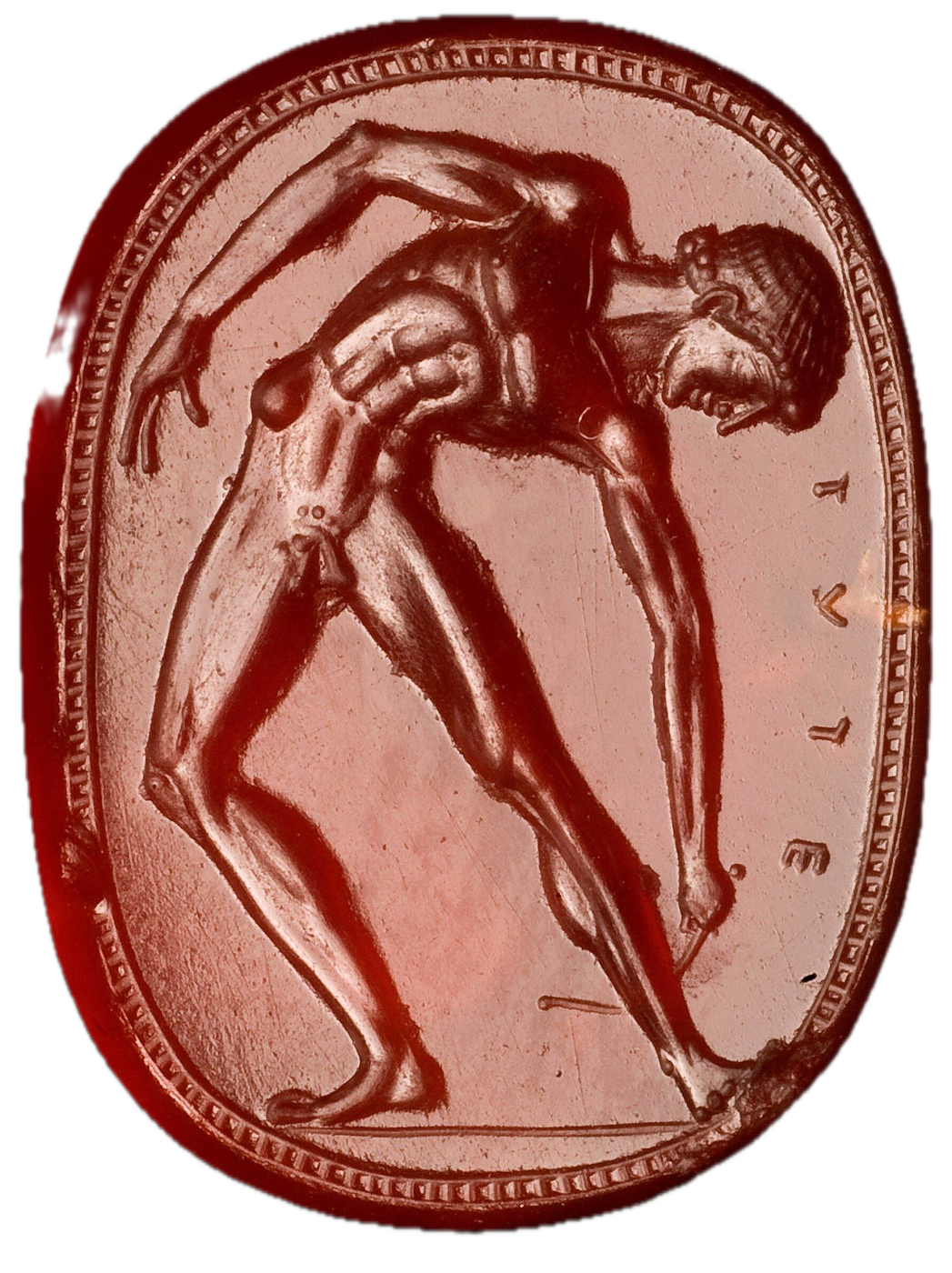
этрусский скарабей с Тидеем. Antikensammlung Berlin. Public domain. https://www.wikidata.org/wiki/Q61439113
See all 1
04 / PROVENANCE
Sources and verification
The character is matched to the catalogue.
- Wikipedia · Tydeus · CC BY-SA 4.0
Excerpt; remaining sentences omitted.
Reference material remains distinct from the poem’s assertions. Characters who share a name retain separate pages.