Ареифой
Mortal man
A character named in Homer's Iliad. The English introduction is not yet available.
Explore on the graph- Mentions
- 3
- Connected characters
- 1
- Books
- 1


Mentions in the Iliad
A. T. Murray, Loeb Classical Library, Harvard University Press, 1924 · Homer, Iliad with an English Translation · CC BY-SA 3.0 US
“a fair wind when they have grown weary of beating the sea with polished oars of fir, and with weariness are their limbs fordone; even so appeared these twain to the longing Trojans. Then the one of them slew the son of king Areithous, Menesthius, that dwelt in Arne, who was born of the mace-man”
“beneath the walls of Pheia about the streams of Iardanus. On their side stood forth Ereuthalion as champion, a godlike man, bearing upon his shoulders the armour of king Areithous, goodly Areithous that men and fair-girdled women were wont to call the mace-man,”
See all 3
Connections
Son · Sources
Son · Sources
a fair wind when they have grown weary of beating the sea with polished oars of fir, and with weariness are their limbs fordone; even so appeared these twain to the longing Trojans. Then the one of them slew the son of king Areithous, Menesthius, that dwelt in Arne, who was born of the mace-manAreithous and ox-eyed Phylomedusa; and Hector with his sharp spear smote Eioneus on the neck beneath the well-wrought helmet of bronze, and loosed his limbs. And Glaucus, son of Hippolochus, leader of the Lycians, made a cast with his spear in the fierce conflict at Iphinous,

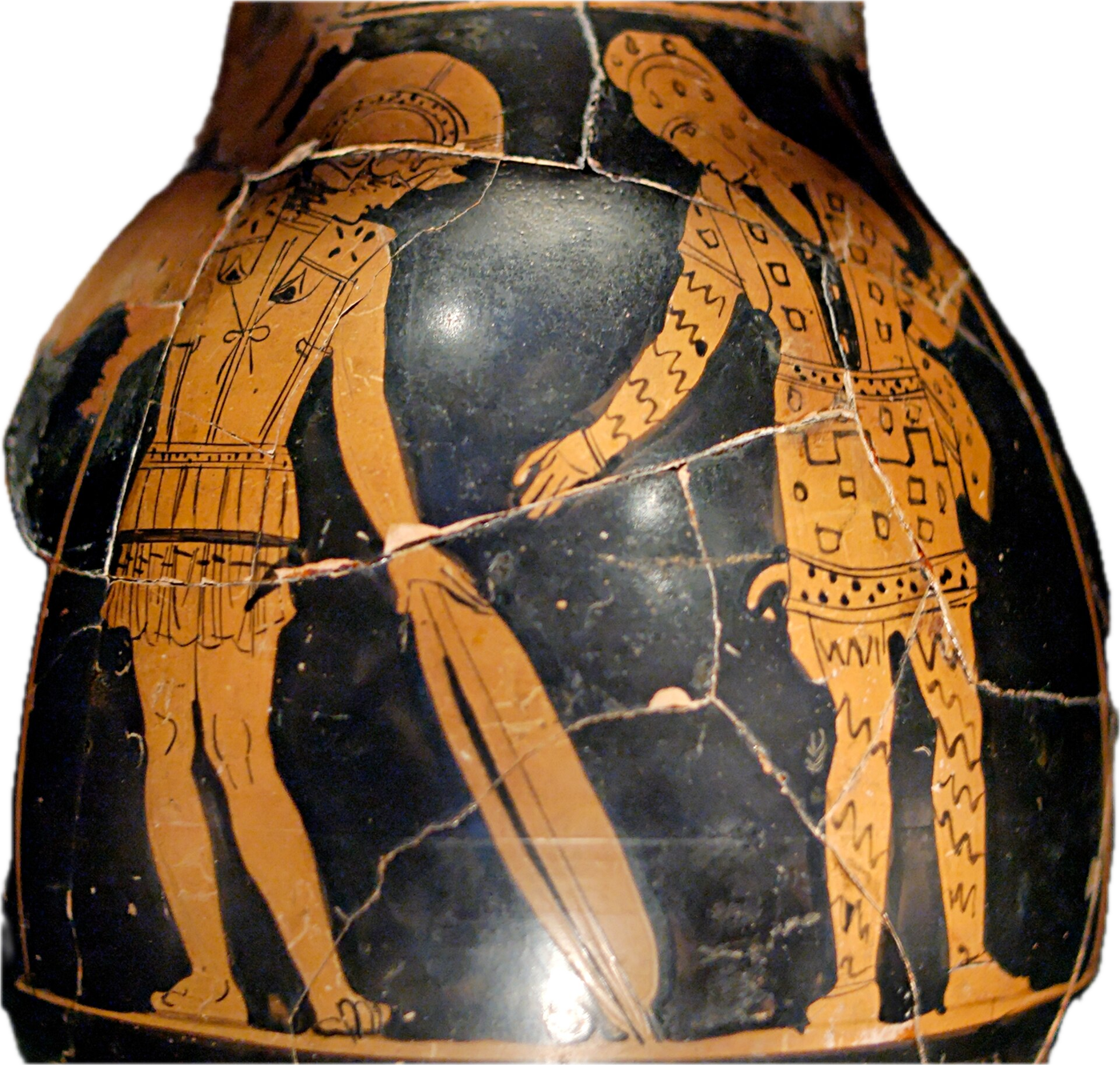
Il. 7.9–10
See all 1
In art
See all 0
There is nothing in this section yet.
04 / PROVENANCE
Sources and verification
The character is matched to the catalogue.
Reference material remains distinct from the poem’s assertions. Characters who share a name retain separate pages.